LEGAL UPDATE No. 02/2026
01 July 2026
On 16 June 2026, the Vietnam Competition Commission and the Legal Affairs Department of the Ministry of Industry and Trade held a public consultation workshop on a draft Law amending the Commercial Law 2005, the Competition Law 2018, the Law on Foreign Trade Management 2017, and the Law on Protection of Consumers’ Rights 2023 (the “Draft Law”). The Ministry of Industry and Trade plans to submit the Draft Law dossier to the Government by 10 July 2026 before submitting it to the National Assembly for consideration at its second 2026 session, expected in October 2026.
The proposed amendments to the Competition Law are extensive, introducing around 20 changes across market definition, market power, abuse of dominance, merger control, sanctions and procedural rules. Many are intended to address the rapid growth of digital platforms, e-commerce and data-driven business models that were not fully contemplated when the current law was enacted in 2018.
Set out below are the key proposed amendments and their practical implications for businesses.
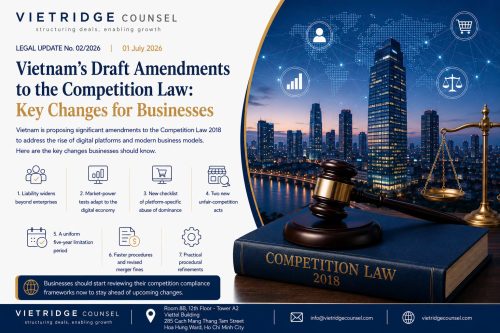
1. Liability widens beyond enterprises
Under the current law, only enterprises can be held liable for anti-competitive conduct. The Draft Law extends liability to any organisation or individual that organises, pressures, mobilises or assists an enterprise in committing such a violation. This could extend to trade associations, advisers and individual executives, rather than only the enterprises directly involved.
2. Market-power tests adapt to the digital economy
Alongside the traditional revenue- and volume-based tests, the Draft Law introduces additional indicators for assessing market share and “significant market power” in digital markets, including the number of users, the number of suppliers on a platform, and transaction or visitor volumes.
Significant market power would also be assessed by reference to data control, network effects, ecosystem integration and the use of algorithms or AI to influence prices or user behaviour. Operators of search, e-commerce, social media, video-sharing, advertising, operating-system and cloud platforms can therefore expect increased regulatory scrutiny, even where revenue alone would not suggest market dominance.
3. A new checklist of platform-specific abuse of dominance
Building on the expanded market-power criteria, the Draft Law identifies several platform practices that may constitute abuse of a dominant position, including self-preferencing an operator’s own products in rankings or algorithms, requiring users to subscribe to bundled services as a condition of platform access, preventing users from uninstalling pre-installed applications or switching to competing services, and denying business users reasonable access to their own transaction data.
These proposals reflect broader international regulatory trends, including those seen under the EU Digital Markets Act, and point to a more detailed compliance framework for major digital platform operators in Vietnam.
4. Two new unfair-competition acts
The Draft Law adds two new forms of unfair competition:
(i) misusing the power to grant, renew, suspend or revoke a distribution or sales licence to obstruct a business partner without good cause; and
(ii) using signs, designs or imitation online storefronts that cause confusion as to the identity or origin of goods or services.
The first targets gatekeeping practices by dominant distributors or platforms, while the second addresses deceptive imitation storefronts, particularly on e-commerce platforms.
5. A uniform five-year limitation period
The Draft Law introduces a five-year statute of limitations for administrative sanctions covering restrictive agreements, abuse of dominance, merger-control violations and unfair competition. This removes the existing uncertainty regarding the applicable limitation period for competition enforcement.
6. Faster procedures and revised merger fines
Several procedural deadlines would be shortened. The decision period for exemption applications would decrease from 60 days to 45 days, while the period for supplementing an incomplete complaint dossier would be reduced from 30 days to 15 days.
The Draft Law also revises the maximum fine for merger-control violations to the lower of VND 2 billion or 5% of the violating enterprise’s revenue, replacing the current percentage-based approach. In addition, the Chairperson of the National Competition Commission may delegate sanctioning authority for merger-control and unfair-competition cases to a deputy.
Businesses contemplating reportable M&A transactions should also take these shorter review timelines into account when planning transaction timetables.
7. Practical procedural refinements
Beyond the headline reforms, the Draft Law also streamlines several procedural aspects, including:
(i) shortening the period for supplementing an incomplete exemption application from 30 to 25 working days, while treating an application as accepted once the Commission issues a notice confirming the completeness of the dossier;
(ii) allowing consultation responses between government agencies to be submitted by post, online or through the national document exchange system, while providing for more detailed rules on the contents of consultation and notification dossiers for exemption applications and merger reviews;
(iii) providing a clearer list of routine intra-group restructurings, acquisitions and joint ventures that do not constitute economic concentration; and
(iv) clarifying the required contents of competition decisions and removing the need for a
separate administrative violation record once such a decision has been issued.
A draft still open to change
The Draft Law remains at the consultation stage. It has yet to be submitted to the Government, let alone considered by the National Assembly.
The overall direction of the proposed amendments is nevertheless clear. Vietnam’s competition regime is moving towards closer regulation of digital platforms, data-driven markets and algorithm-driven business conduct, while introducing faster enforcement procedures and expanding the range of parties that may be held liable.
Businesses operating digital platforms, multi-sided marketplaces or extensive distribution networks in Vietnam should begin reviewing their competition compliance frameworks now, rather than waiting for the legislation to be finalised.
Mitigate anti-trust risks and streamline your merger control compliance before executing transactions. Partner with our specialized M&A Deal Counsel Team to design legally resilient corporate structures that align with evolving competition thresholds
Contact
Le Nguyen Huy Thuy
Managing Partner
VIETRIDGE COUNSEL