LEGAL UPDATE No. 03/2026
13 July 2026
On 7 July 2026, the Government issued Decree No. 274/2026/ND-CP (“Decree 274“), providing detailed regulations for the selection of investors for business investment projects under the Law on Bidding. Decree 274 will take effect on 21 August 2026, replacing Decree No. 23/2024/ND-CP, Decree No. 115/2024/ND-CP and Decree No. 225/2025/ND-CP, which previously governed different categories of investor selection.
Rather than introducing an entirely new investor selection regime, Decree 274 brings together rules that were previously scattered across several decrees into a single regulatory framework. The result is a more streamlined set of procedures for investors participating in business investment projects in Vietnam.
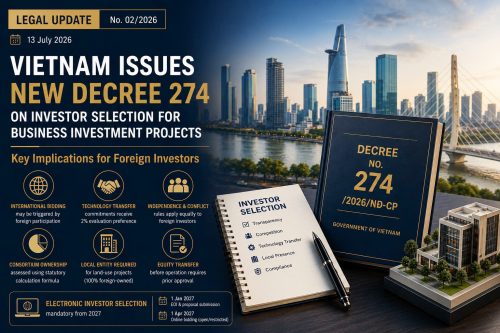
1. International bidding may be triggered by foreign investor participation
For projects subject to the Expression of Interest (EOI) procedure – including certain projects in the social housing, healthcare, education and energy sectors – Decree 274 specifies when the investor selection process must be conducted through international open bidding.
Under Article 43(2), international open bidding applies where at least one foreign investor satisfies the eligibility requirements set out in the EOI documents. If no eligible foreign investor participates, domestic open bidding will apply instead.
This distinction has an important practical implication. Once qualified foreign participation exists, the project automatically becomes subject to international bidding procedures, including bilingual procurement documents and longer minimum bidding timelines.
2. Technology transfer commitments may improve bid competitiveness
Decree 274 introduces several preferential mechanisms during bid evaluation. Among them, Article 6(1)(d) provides that a foreign investor committing to transfer technology to a Vietnamese investor or partner is entitled to a 2% evaluation preference.
The preference is calculated in accordance with the statutory formula prescribed under Article 6(3).
To qualify, investors must submit supporting documentation demonstrating their legal right to own, use and transfer the relevant technology under Vietnam’s laws on technology transfer, high technology and intellectual property.
Technology transfer should therefore be considered not only from a commercial perspective but also as a factor that may enhance the competitiveness of a bid.
3. Independence and conflict-of-interest rules apply equally to foreign investors
Article 5 establishes detailed rules intended to preserve the integrity of the investor selection process.
From the date the EOI documents or tender documents are issued, an investor submitting an application or bid must remain legally and financially independent from the competent authority, the procuring entity and the consulting organisations involved in preparing the bidding documents.
For corporate groups, Article 5(5) further provides that a parent company and its subsidiaries (or a consortium comprising such entities) may participate in only one bid for the same project.
This restriction is particularly relevant for multinational groups operating through offshore holding companies, SPVs or multiple affiliated entities.
4. Consortium ownership is assessed using a statutory calculation formula
Where bids are submitted through a consortium, Article 5(3) prescribes a specific formula for calculating ownership interests when assessing compliance with the independence requirements.
Rather than looking solely at direct ownership, the Decree takes into account both the investor’s ownership percentage in the relevant entity and its participation ratio within the consortium.
Foreign investors participating through consortium structures should therefore review their ownership arrangements carefully before submitting bids, particularly where multiple affiliated entities are involved.
5. Foreign winning bidders must establish a Vietnamese project company for land-use projects
Article 55 permits a successful investor to implement a project directly or through a project company established for that purpose.
However, where the project involves land allocation or land lease, a foreign investor must establish a legal entity in Vietnam before land can be allocated or leased for project implementation.
The newly established entity must initially be wholly owned by the successful investor and satisfy the applicable requirements under the laws on land, investment, enterprises, real estate business and other relevant legislation.
In practice, this means that a foreign investor cannot directly receive land allocation or land lease in its own name after winning the tender. Appropriate acquisition and project structures should therefore be considered at an early stage of the investment process.
6. Equity transfers before project operation require prior approval
Article 56(5) requires prior approval from the competent authority for any transfer of shares or contributed capital in the project company before the project enters its operational phase.
The incoming investor must satisfy the applicable legal conditions, assume the obligations undertaken by the original investor under the bidding documents and project contract, and meet any additional conditions imposed by the competent authority.
This restriction is intended to discourage investors from transferring awarded projects before fulfilling their implementation commitments.
7. Electronic investor selection will become mandatory from 2027
Decree 274 establishes a phased transition to the National Bidding Network System.
Electronic submission of project proposals and online EOI procedures will apply from 1 January 2027, while full online bidding for projects applying open or restricted tender procedures will become mandatory from 1 April 2027.
Investors intending to participate in Vietnam’s investor selection processes should begin preparing their internal compliance systems and electronic bidding capabilities before these requirements become mandatory.
Key Takeaways for Foreign Investors
Before participating in any investor selection process in Vietnam, foreign investors should consider at an early stage:
- whether the project may be subject to international bidding;
- whether technology transfer commitments could improve bid competitiveness;
- whether the proposed consortium structure satisfies the independence requirements;
- whether a Vietnamese project company will be required for land-related projects; and
- whether any future equity transfer could require prior regulatory approval.
Addressing these issues during the transaction planning stage may help minimise restructuring costs, regulatory delays and implementation risks later in the investment process.
Conclusion
While Decree 274 is largely procedural in nature, its practical impact should not be underestimated. Many of its provisions will influence how foreign investors structure consortium arrangements, project vehicles and implementation strategies well before a bid is submitted. Investors should therefore consider these requirements at the planning stage to minimise execution risks and avoid unnecessary restructuring later in the investment process.
Contact
Le Nguyen Huy Thuy
Managing Partner
VIETRIDGE COUNSEL
E: thuy.le@vietridgecounsel.com