LEGAL UPDATE No. 08/2026
10 September 2026
On 3 September 2026, the Government issued Decree No. 342/2026/NĐ-CP (“Decree 342“), providing detailed regulations under the Commercial Law and the Law on Foreign Trade Management on trading rights and activities directly related to the sale and purchase of goods by foreign investors and foreign-invested enterprises (“FIEs“) in Vietnam. Decree 342 takes effect on 18 October 2026 and replaces Decree No. 09/2018/NĐ-CP (“Decree 09“) in its entirety.
Decree 342 changes the licensing framework in three principal respects. Licensing authority moves from the provincial Department of Industry and Trade to the relevant provincial People’s Committee. A national-security consultation with the Ministry of Public Security and the Ministry of National Defence is introduced for specified cases, including certain non-treaty investors, foreign-controlled operators of large digital platforms and large retail chains. Decree 342 also removes or narrows several licensing conditions and introduces a transition mechanism for existing retail outlets following an M&A transaction. This Legal Update focuses on the last group of changes.
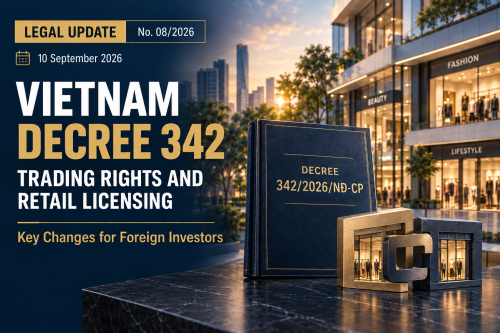
Key changes under Decree 342/2026/NĐ-CP for foreign investors engaging in trading and retail activities in Vietnam.
1. The separate financial-plan requirement has been removed
Under Decree 09, an application for a Business Licence or a Retail Outlet Establishment Licence had to include a financial plan and supporting financial information. Decree 342 removes that separate requirement. An applicant must still submit a five-year business plan covering the proposed activities, market-development plan, labour requirements and expected socio-economic impact (Articles 11.2(b) and 25.2(b)). The change therefore reduces the prescribed financial documentation, but does not remove the need to substantiate the proposed business model or satisfy the other licensing conditions.
2. Job creation and State-budget contribution are no longer licensing assessment criteria
For investors from countries or territories outside the relevant treaty framework, Decree 09 required the licensing authority to consider, among other matters, the applicant’s capacity to create employment in Vietnam and its expected contribution to the State budget. These factors also formed part of the ENT assessment for additional retail outlets. Decree 342 no longer lists either factor as a licensing or ENT criterion. The remaining criteria focus on compliance with sector-specific law and the level of competition among domestic enterprises and, for ENT, the proposed outlet’s effects on the relevant geographic market and its contribution to retail-sector development and local living conditions (Articles 9.2(b) and 22.2). Labour requirements and socio-economic impact must nevertheless still be addressed in the five-year business plan.
3. ENT is narrowed for investors covered by treaty commitments abolishing the test
Under Decree 09, an ENT generally applied to each retail outlet beyond the first, subject to an exception for an outlet of less than 500 m² located in a shopping mall and not operating as a convenience store or mini-supermarket. Decree 342 retains that exception and further narrows the scope of ENT. The test now applies to an additional retail outlet only where the foreign investor is from a country or territory that does not participate in a treaty to which Vietnam is a party and under which Vietnam has committed to abolish ENT (Article 22.1). Investors relying on this exemption should verify that the applicable treaty commitment covers the relevant investor and retail activity; participation in a treaty with Vietnam does not, by itself, disapply ENT.
4. A 12-month transition period supports continuity of existing retail operations after M&A
This change is particularly relevant to acquisitions of Vietnamese retail businesses. Under Decree 09, when a Vietnamese enterprise with operating retail outlets received foreign investment and became subject to the foreign-invested enterprise licensing regime, the legislation did not expressly address whether those outlets could continue operating while the enterprise obtained a Business Licence and Retail Outlet Establishment Licences. This created uncertainty between closing and completion of the licensing process.
Article 5.6(c) of Decree 342 now permits the target enterprise to continue retail operations at its existing outlets while it completes the procedures for the required Business Licence and Retail Outlet Establishment Licences, subject to an outer limit of 12 months from the date stated in the relevant legal document or written confirmation that the foreign investor satisfies the conditions for the capital contribution, share purchase or acquisition of a capital contribution. The application for licences allowing the existing outlets to continue operating must be filed within 30 days from that confirmation (Article 36.2(a)). Transaction documents should therefore allocate responsibility for the filings, information and cooperation required to meet both the 30-day filing deadline and the 12-month long-stop date.
5. Other changes affecting licensing and ongoing compliance
Decree 342 also changes several requirements that affect licensing and continuing operations. For a retail outlet, the location must now satisfy applicable requirements on land, planning, investment, construction, fire prevention and fighting, traffic safety and environmental hygiene, rather than being assessed only for consistency with the relevant planning (Article 21.1(b)). A tax-clearance document submitted with an application must be dated no more than six months before filing. The business term granted to an investor relying on an applicable treaty market-access commitment now corresponds to the term of its Enterprise Registration Certificate, if any (Article 10.2(a)). FIEs must report twice each year, by 15 January for the annual reporting period and by 15 July for the first six months of the year (Article 38.1(a)). For specified supporting documents, submission is required only where the licensing authority cannot retrieve complete and accurate information from the relevant national or specialised databases.
Practical note
The new regime does not regularise existing non-compliance. An FIE must continue to satisfy the conditions applicable to its licensed activities. If it fails to do so, it must suspend the affected activities when required by a decision of the competent authority while it remedies the failure; if the conditions are not restored within 12 months, the affected business or retail-outlet activities must be terminated (Article 40). Decree 342 also provides for licence revocation following a third administrative penalty within 12 months for violations of the activities recorded in the relevant licence (Article 42.1(g) and 42.2(h)). For retail M&A transactions already in progress, the transition mechanism should be treated as a limited period to complete mandatory licensing, not as an exemption from licensing. The 30-day filing deadline, regulatory review period and 12-month long-stop date should be reflected in the closing timetable and post-closing covenants.
Our Investment & FDI Advisory Team assists foreign investors and foreign-invested enterprises with market entry, retail licensing, investment structuring, M&A transactions and regulatory compliance in Vietnam.
Disclaimer
This Legal Update is for general informational purposes only and should not be construed as legal advice. For specific guidance tailored to your situation, please contact Vietridge Counsel.
Contact
Le Nguyen Huy Thuy
Managing Partner
VIETRIDGE COUNSEL
E: thuy.le@vietridgecounsel.com