LEGAL UPDATE No. 06/2026
21 August 2026
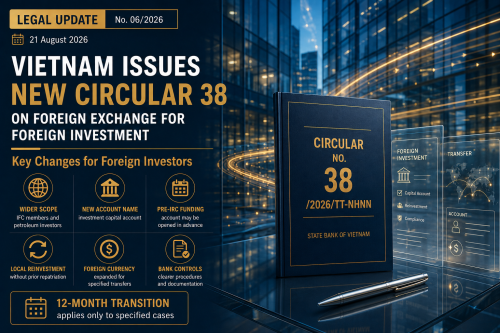
On 31 July 2026, the State Bank of Vietnam issued Circular No. 38/2026/TT-NHNN (“Circular 38”), replacing Circular No. 06/2019/TT-NHNN (“Circular 06”). Circular 38 took effect on 18 August 2026 and sets out the new foreign exchange management regime for foreign investment activities in Vietnam.
The new Circular is broader in scope than the one it replaces. It no longer regulates only foreign direct investment into Vietnam; it now covers foreign investment activities in Vietnam more generally and brings additional categories of investors and structures into a single regulatory framework.
Set out below are the key changes under Circular 38 most relevant to foreign investors and foreign-invested enterprises (“FIEs”) operating or investing in Vietnam.
1. Wider scope and new terminology
Circular 38 continues to apply to FIEs, foreign investors participating in BCC arrangements and foreign investors directly implementing PPP projects without establishing a project enterprise. It expands the framework to include member enterprises of Vietnam’s International Financial Centre (“IFC member enterprises”) and foreign investors in petroleum activities.
The former term “direct investment capital account” is replaced with “foreign investment capital account in Vietnam”, shortened in Circular 38 to “investment capital account”. Circular 38 also replaces the former terminology in earlier circulars issued by the State Bank of Vietnam. Enterprises should therefore update bank mandates, transaction documents and internal templates that still refer to a direct investment capital account.
2. Ownership threshold: consolidated, not new
For an enterprise falling within Article 6.1(b), the investment capital account regime applies where foreign investors or IFC member enterprises hold more than 50 per cent of its charter capital. Enterprises established by a foreign investor or an IFC member enterprise are separately covered under Article 6.1(a).
This is not a new rule introduced by Circular 38. The threshold was already changed from “51 per cent or more” to “more than 50 per cent” by Circular No. 03/2025/TT-NHNN in 2025. Circular 38 consolidates the current position into the new framework. Enterprises that already adjusted their account arrangements under Circular 03 should not expect a further change on this specific threshold.
3. New flexibility before licensing is complete
A new feature is the ability of an enterprise established by a foreign investor before completion of the procedure for issuance or amendment of its Investment Registration Certificate (“IRC”) to open an investment capital account in advance. Until the IRC is issued or amended, the account may only be used to receive charter capital contributions and interest on the balance, pay lawful pre-investment expenses in Vietnam, or refund capital if the IRC is not issued or amended.
This gives investors more flexibility in sequencing enterprise establishment, funding and investment licensing. Investors should nevertheless be prepared to provide documents supporting the amount and purpose of each transfer as required by the authorised bank and to supplement the relevant licensing documents once issued or amended.
4. Reinvestment without repatriation
Circular 38 expressly allows foreign investors and IFC member enterprises that do not remit capital received following a capital reduction, transfer, termination or liquidation, or profits and other lawful proceeds, outside Vietnam or into the International Financial Centre to transfer those amounts from the investment capital account to their payment account at an authorised bank. The funds may then be used for another project or investment activity in Vietnam in accordance with investment law, without first being remitted abroad and brought back into Vietnam.
This is a practical improvement for investors reinvesting locally, although the applicable investment, accounting, tax, foreign-exchange and anti-money-laundering requirements continue to apply.
5. Foreign-currency flexibility and enhanced bank controls
Circular 38 retains the ability of non-resident investors to value and settle transfers of capital or investment projects in foreign currency and extends this treatment to transfers between a non-resident investor and an IFC member enterprise, and between IFC member enterprises. Transactions involving a resident investor generally remain VND-denominated, subject to the specific foreign-currency exceptions for petroleum-related transfers.
Circular 38 also requires authorised banks to adopt and publicly disclose internal rules governing the documents and procedures for opening and using investment capital accounts and the transparency of investment-related fund flows. Each transfer instruction must state the amount and purpose of the transfer. Banks must verify and retain supporting documents and comply with applicable anti-money-laundering, counter-terrorist-financing and proliferation-financing requirements. Investors should therefore be prepared for structured documentary review under the bank’s published procedures.
6. Transitional arrangements
Circular 38 provides a 12-month transition period from 18 August 2026 for foreign investors that were already conducting petroleum activities before that date to complete the opening of an investment capital account. The same deadline applies to accounts that had not yet been closed in two specified cases: where an enterprise no longer had any foreign investor or IFC member enterprise as a shareholder or member; and where an enterprise had not been issued an IRC or had not obtained an amendment to its IRC and had refunded the contributed funds.
The 12-month transition period does not apply where foreign or IFC-member ownership falls to 50 per cent or below, or where an FIE becomes a public company with shares listed or registered for trading. Those cases fall under Article 7.5(b), whereas Article 19.3 refers only to Article 7.5(a)(i) and (ii). Subject to the exception for an account being used for foreign borrowing, debt repayment or another lawful payment obligation, the investment capital account must be closed. Any foreign investor or IFC member enterprise that continues to hold shares or a capital contribution must thereafter conduct receipts and payments relating to that investment through an indirect investment account in accordance with the applicable foreign-exchange rules.
Practical note
Circular 38 is a comprehensive replacement of Vietnam’s foreign-exchange framework for foreign investment, not merely a terminology update. Foreign investors and FIEs should review whether they are required to open, maintain or close an investment capital account; update the terminology used in banking and transaction documents; and assess any pending capital contribution, ownership change, IRC procedure, transfer, profit distribution or reinvestment against the new requirements. Early engagement with the account bank is advisable where a transaction is already underway or depends on a transitional arrangement.
Our Investment & FDI Advisory Team assists foreign investors and foreign-invested enterprises with market entry, investment structuring, capital-account compliance and cross-border transactions in Vietnam.
Disclaimer
This Legal Update is for general informational purposes only and should not be construed as legal advice. For specific guidance tailored to your situation, please contact Vietridge Counsel.
Contact
Le Nguyen Huy Thuy
Managing Partner
VIETRIDGE COUNSEL
E: thuy.le@vietridgecounsel.com